
Join us for wine tasting! Open daily 10am-5pm.
Want to save 20%? Join our Wine Club and start saving today. Learn More.
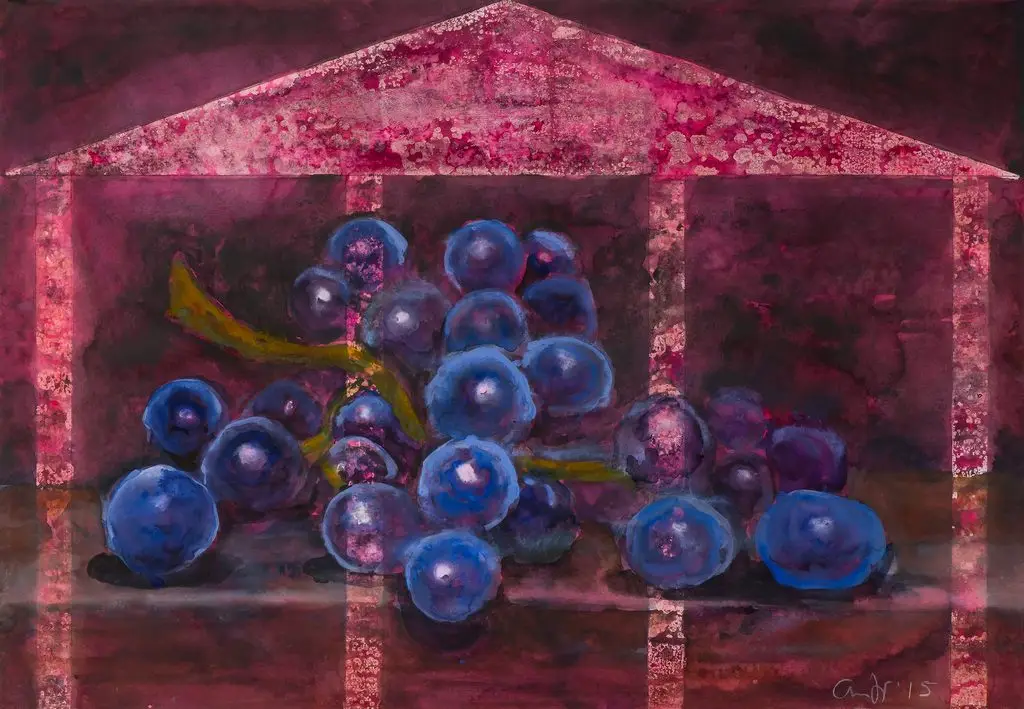
In Blueberries, Aaron Fink transforms an everyday subject into a striking visual exploration of color, form, and perception. What might initially appear to be a simple still life reveals itself as a careful study of shape, light, and texture, inviting viewers to slow down and appreciate the beauty found in ordinary objects. By isolating a familiar motif and elevating its presence through scale, color, and composition, Fink encourages a deeper engagement with the act of looking itself.
The work reflects Fink’s longstanding fascination with commonplace items, which frequently serve as the subjects of his paintings. Rather than focusing on narrative, the artwork emphasizes the visual and sensory qualities of the blueberries, allowing subtle variations in color, surface, and spatial relationships to take center stage. Through this approach, the familiar becomes unexpectedly dynamic and memorable.
Blueberries celebrates the richness that can be found in the ordinary, demonstrating how a simple object can become a vehicle for artistic exploration. The resulting composition balances realism and abstraction, drawing attention to the materiality of paint while preserving the recognizable essence of its subject. As with much of Fink’s work, the painting invites contemplation, revealing new nuances with each viewing.
For Blueberries, Aaron Fink approached the subject through a process of observation, repetition, and experimentation. Known for revisiting everyday objects in multiple paintings, Fink uses familiar subjects as a starting point for exploring the expressive possibilities of paint itself. Rather than focusing solely on accurate representation, he develops each work through layers of color and surface manipulation, allowing the painting process to become an essential part of the final image.
Throughout the creation of the work, successive layers of paint are built up and reworked using techniques such as squeegeeing, scraping, and blending. These methods create subtle variations in texture, depth, and color, transforming a simple arrangement of blueberries into a vibrant study of light, form, and materiality. By continually refining the surface, Fink achieves a balance between realism and abstraction, where the subject remains recognizable while the paint itself takes on an active visual presence.
The result is a composition that celebrates both the ordinary beauty of its subject and the physical process of painting. Through careful attention to color relationships, shape, and surface quality, Aaron Fink elevates a familiar object into a compelling visual experience, inviting viewers to look more closely at the world around them.
Aaron Fink is an American painter, printmaker, and sculptor whose work transforms familiar everyday objects into compelling studies of color, light, and form. Born in Boston in 1955, Fink earned a BFA from the Maryland Institute College of Art and an MFA from the Yale University School of Art. Over the course of his career, he has become known for elevating ordinary subjects such as fruit, desserts, household objects, and still-life arrangements through a distinctive painting style that combines realism with painterly abstraction.
Rather than focusing on narrative, Aaron Fink uses commonplace objects as vehicles for exploring the physical qualities of paint and the act of seeing. His works are built through multiple layers of color and surface manipulation, creating images that are both familiar and visually dynamic. This approach allows viewers to appreciate the subtle beauty and complexity hidden within everyday experiences.
Fink’s artwork has been exhibited internationally and is represented in the collections of major institutions, including the Museum of Modern Art, the Metropolitan Museum of Art, the National Gallery of Art, the Art Institute of Chicago, and the Museum of Fine Arts, Boston. Through his innovative use of color, texture, and composition, he continues to demonstrate how ordinary subjects can inspire extraordinary visual experiences.