
Join us for wine tasting! Open daily 10am-5pm.
Want to save 20%? Join our Wine Club and start saving today. Learn More.
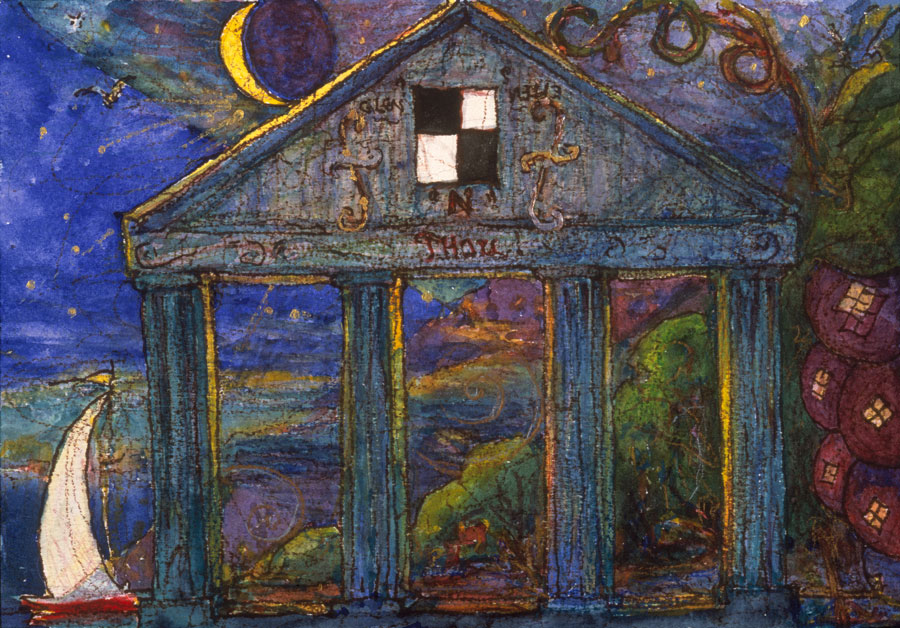
For Glen Ellen Winery reflects the inventive spirit and visual wit that defined the work of William T. Wiley. Blending imagery, symbolism, and playful references, the composition invites viewers into a world where observation, storytelling, and imagination intersect. Rather than presenting a straightforward narrative, the artwork encourages exploration, allowing meaning to emerge through unexpected connections, layered details, and moments of humor. Wiley’s ability to combine intellectual curiosity with visual spontaneity creates a work that feels both deeply personal and universally engaging.
Like much of Wiley’s work, For Glen Ellen Winery balances artistic freedom with thoughtful commentary. The composition draws upon themes of place, nature, and human experience, while embracing the inventive energy associated with the Bay Area Funk Art movement. Through a dynamic interplay of imagery, color, and symbolic forms, the piece rewards close examination, revealing new details and interpretations over time. The result is a work that celebrates creativity, invites reflection, and captures the playful yet profound approach that made William T. Wiley one of California’s most influential artists.
William T. Wiley’s creative process was driven by experimentation, observation, and an openness to unexpected connections. Working across drawing, painting, printmaking, and mixed media throughout his career, Wiley often developed compositions through an accumulation of imagery, symbols, written elements, and visual references that evolved as the work progressed. Rather than following a rigid plan, he embraced a fluid approach that allowed ideas to emerge organically, creating layers of meaning and visual intrigue.
Throughout the development of the artwork, Wiley balanced humor, intellectual curiosity, and personal reflection, weaving together elements of narrative and abstraction. His process frequently incorporated wordplay, symbolic imagery, and unconventional juxtapositions, encouraging viewers to engage with the work on multiple levels. Associated with the Bay Area Funk movement, Wiley favored creativity, spontaneity, and individuality over strict formalism, resulting in compositions that feel both playful and deeply thoughtful.
The finished piece reflects this layered method of working, where each mark, image, and visual relationship contributes to a larger conversation about place, experience, and imagination. By allowing intuition and discovery to guide the creative journey, William T. Wiley transformed ordinary ideas into richly engaging works that continue to reward close observation and personal interpretation.
William T. Wiley (1937-2021) was an influential American artist whose multidisciplinary practice spanned painting, drawing, printmaking, sculpture, film, performance, and mixed media. A central figure in the California and Bay Area art scene, Wiley became closely associated with the Funk Art movement, which embraced humor, experimentation, personal expression, and an irreverent departure from traditional artistic conventions. He studied at the California School of Fine Arts (now the San Francisco Art Institute) and later taught at University of California, Davis, where he influenced a generation of artists through his inventive and unconventional approach to artmaking.
Throughout his six-decade career, William T. Wiley developed a highly recognizable visual language that blended wit, wordplay, symbolism, and social commentary. His works often combined text, imagery, found objects, and layered narratives, encouraging viewers to engage with art as both a visual and intellectual experience. Wiley’s work has been exhibited internationally and is included in the collections of major institutions, including the Museum of Modern Art, the Whitney Museum of American Art, the Museum of Modern Art, and the Walker Art Center.
Known for balancing humor with thoughtful reflection, Wiley explored themes ranging from nature and the environment to philosophy, language, and human behavior. His enduring legacy lies in his ability to challenge expectations while maintaining a sense of curiosity and playfulness, making him one of the most distinctive and celebrated voices in contemporary American art.