
Join us for wine tasting! Open daily 10am-5pm.
Want to save 20%? Join our Wine Club and start saving today. Learn More.
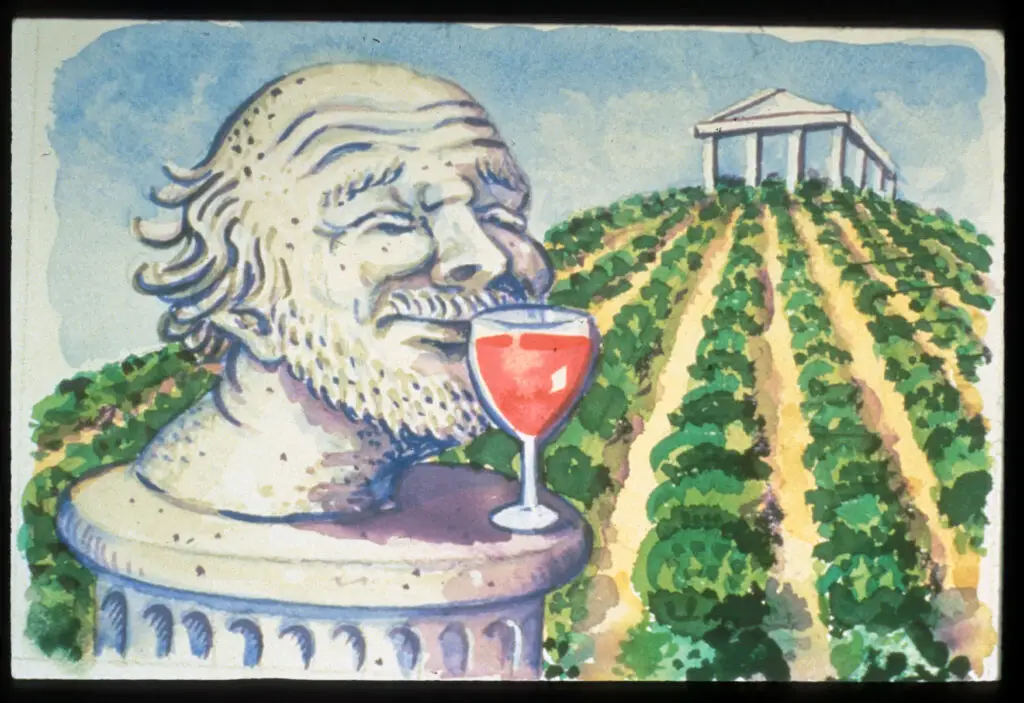
In Old Bacchus, Robert Arneson reimagines the classical figure of Bacchus, the Roman god of wine, revelry, and abundance, through his distinctive blend of humor, satire, and expressive craftsmanship. Rather than presenting an idealized mythological figure, Arneson infuses the subject with a deeply human presence, inviting viewers to consider both the grandeur and imperfections associated with celebration, aging, and indulgence.
Known for challenging artistic conventions, Arneson uses the familiar image of Bacchus as a vehicle for exploring themes of identity, mortality, and cultural tradition. The work balances reverence and irreverence, drawing upon art historical references while maintaining the artist’s characteristic wit and playful spirit. Rich textures, expressive forms, and exaggerated details contribute to the artwork’s dynamic personality and visual impact.
Old Bacchus reflects Arneson’s ability to merge classical subject matter with contemporary sensibilities, transforming a legendary figure into something approachable, thoughtful, and often humorous. The artwork celebrates the enduring symbolism of wine and festivity while encouraging viewers to reflect on the complexities of human nature. Through its inventive interpretation and expressive character, the piece exemplifies Arneson’s influential contribution to contemporary American art.
Robert Arneson approached the creative process with the blend of technical skill, humor, and critical inquiry that defined much of his career. Working primarily in ceramic sculpture, Arneson embraced the medium’s tactile qualities, building forms by hand and allowing the material’s expressive potential to remain visible throughout the finished work. His process often challenged traditional expectations of ceramic art, transforming a historically functional medium into a vehicle for contemporary artistic expression.
In creating Old Bacchus, Arneson drew upon classical mythology while reinterpreting it through a distinctly modern lens. The artist developed the form through modeling, carving, and surface treatments that emphasize individuality and character rather than idealized perfection. Exaggerated features, expressive textures, and subtle details contribute to the work’s sense of personality, reflecting Arneson’s interest in combining satire with art historical references.
Through this process, Arneson transformed the familiar figure of Bacchus into a subject that is both humorous and thought-provoking. The resulting artwork reflects his ability to merge craftsmanship, storytelling, and social commentary, encouraging viewers to engage with mythology, tradition, and human experience in unexpected ways.
Robert Arneson (1930-1992) was a pioneering American artist and one of the most influential figures in the California Funk Art movement. Best known for transforming ceramics into a powerful medium for contemporary artistic expression, Arneson challenged traditional distinctions between fine art and craft through works that combined technical mastery, satire, humor, and social commentary.
Throughout his career, Arneson explored themes of identity, self-portraiture, popular culture, politics, and art history, often employing wit and irreverence to question accepted conventions. His sculptures are characterized by expressive forms, bold surfaces, and a willingness to embrace imperfection, using clay as a vehicle for both personal reflection and cultural critique.
A longtime educator and leading voice in contemporary ceramics, Arneson’s influence extended far beyond his own studio practice. His work has been exhibited internationally and is included in major museum collections throughout the United States. Celebrated for expanding the possibilities of ceramic art, Arneson helped elevate the medium to new prominence within contemporary art.
Through his innovative approach and fearless creativity, Robert Arneson left a lasting legacy that continues to inspire artists today. His work remains admired for its intelligence, humor, craftsmanship, and ability to transform everyday subjects and historical references into engaging, thought-provoking works of art.